Industry News · Buying Guides
Compressor Nebulizer Supplier Checklist: What Importers Should Verify Before Requesting a Quote
A B2B checklist for evaluating compressor nebulizer suppliers before quotation, covering product scope, documentation, labeling, accessories, OEM options, and compliance review.

Preface
For B2B buyers, choosing a compressor nebulizer supplier is not only about comparing unit price. Importers, distributors, pharmacy channels, and private-label healthcare brands need to confirm whether the supplier can support the selected product type, provide model-specific documentation, handle packaging requirements, and prepare a quotation that matches the target market.
A compressor nebulizer project can involve many practical details: base model selection, accessory configuration, instruction manual language, packaging artwork, carton requirements, shipment documents, and after-sales communication. If these points are not clarified before quotation, the buyer may receive an attractive price that does not match the real product, market, or customization requirement.
This checklist is written for professional sourcing teams. It does not replace regulatory advice, and it should not be used as a claim that any specific product is approved for a specific market. Instead, it gives buyers a structured way to ask better questions before moving to samples and purchase orders.
01
Start With the Product Category and Base Model
The first question is simple: which compressor nebulizer models are actually available for quotation?
A supplier should be able to identify the product type, model name, product images, basic product description, accessory options, and available documentation for each model. For AXDCARE, the current published compressor nebulizer product range on the website includes models such as AXD-NB301, AXD-NB301B, AXD-NB307, AXD-NB316, and AXD-NB505. Before using any technical parameter in procurement documents, the buyer should request the latest model-specific product sheet.
Buyers should avoid treating one catalog page as universal proof for every model. Even products in the same category can have different power formats, accessory sets, packaging options, and documentation status.
02
Verify Documentation Before Discussing Final Price
Documentation should be reviewed early. A professional quotation process should connect the product model with the documents that apply to that model.
For a compressor nebulizer project, buyers may need to ask about product specification sheets, instruction manual language options, label and packaging requirements, accessory configuration, available test reports, certificate scope if applicable, export documents, shipment preparation, and artwork approval workflow for OEM orders.
The U.S. FDA product classification database includes a classification entry for a direct patient interface nebulizer. The FDA also has guidance related to nebulizers, metered dose inhalers, spacers, and actuators. These sources are useful as regulatory background for understanding why product type and documentation matter, but they do not prove that a specific supplier model is cleared or approved.
For Europe, the European Commission explains responsibilities across medical device economic operators, including manufacturers, importers, and distributors. This is relevant for B2B sourcing because the buyer may also carry obligations in the destination market.
03
Confirm Accessory and Packaging Requirements
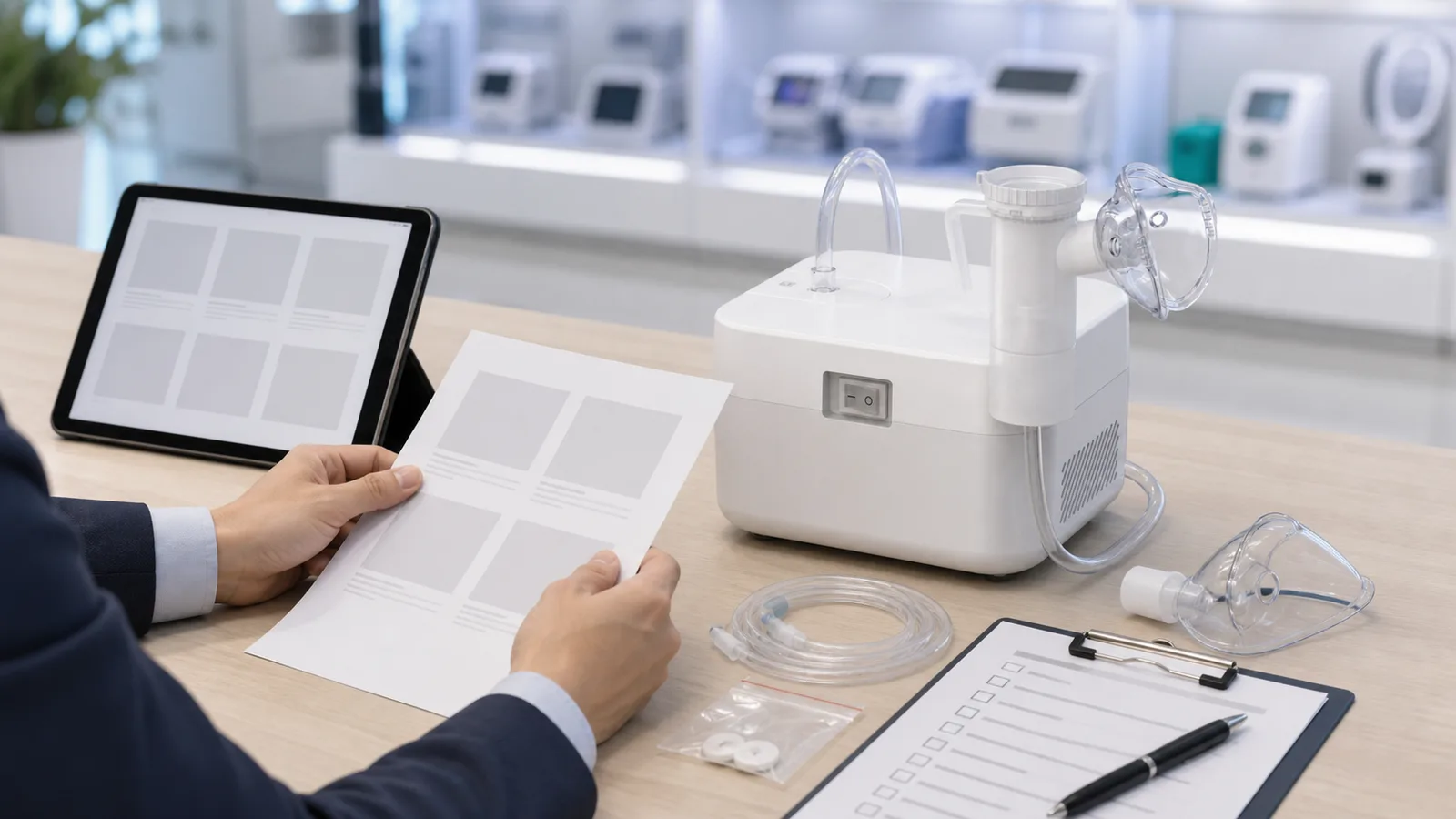
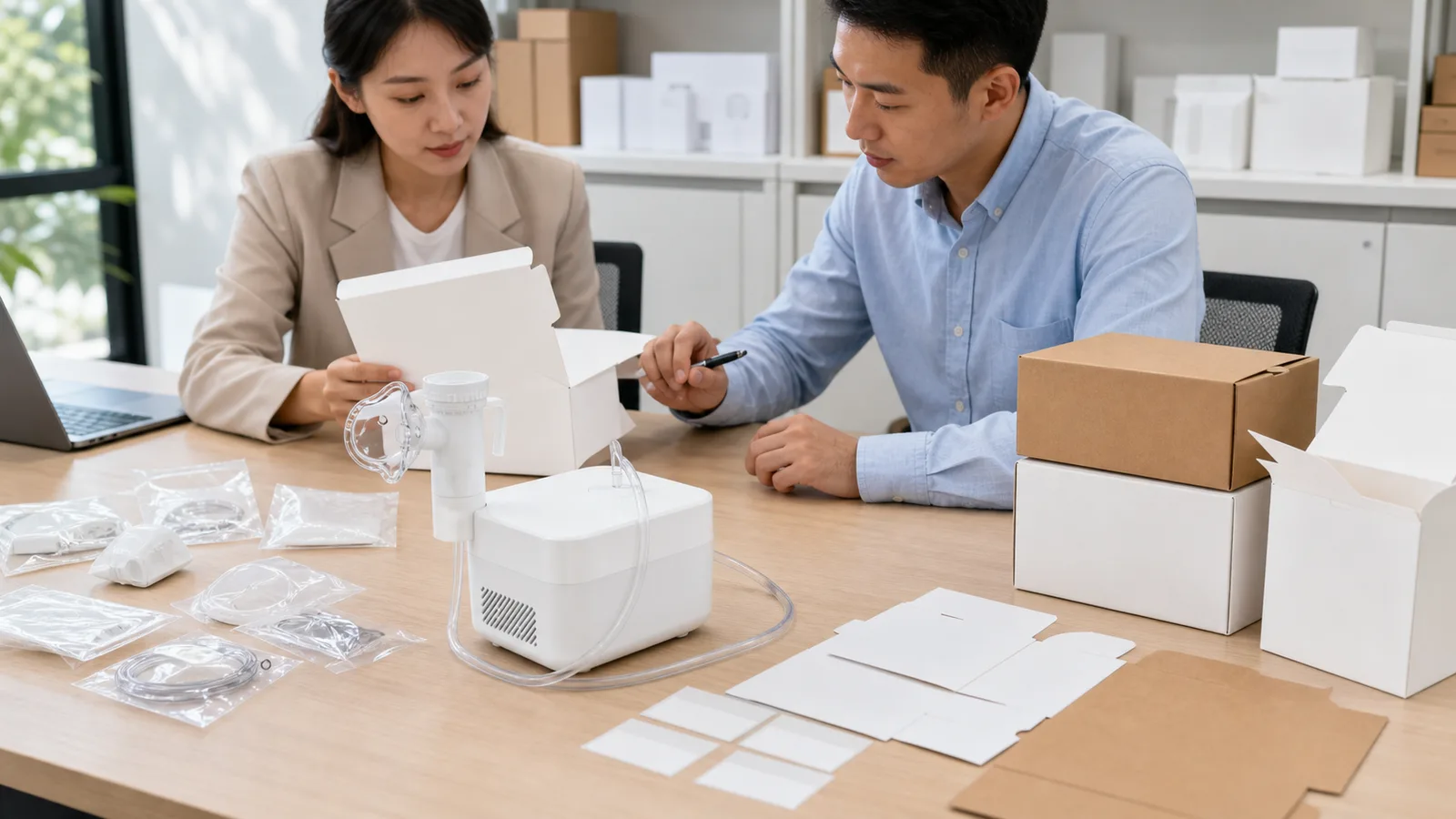
Accessories can change the real quotation. A buyer should confirm which items are included as standard and which items are optional. Masks, tubing, medicine cups, mouthpieces, filters, manuals, adapters, retail boxes, and carton labels should not be assumed unless they are listed in the quotation or product file.
Packaging also matters for private-label and distributor programs. Buyers should prepare clear requirements for retail box format, language, barcode, warning text, product label, carton marks, and shipment labeling. The supplier should confirm which parts can be customized and which information must remain based on product documentation or destination-market requirements.
If artwork is involved, the buyer should provide vector logo files, color references, package layout requirements, and manual language needs before sample approval. Mass production should not start from verbal requirements only.
04
Ask About OEM and Private-Label Workflow
OEM work should begin with a confirmed base model. For compressor nebulizers, common OEM discussion points include logo placement, shell color, packaging design, manual language, accessory combination, and carton labeling.
The buyer should ask the supplier to separate confirmed options from items that require review. For example, a supplier may be able to review logo, color, label, manual, and package customization after artwork review, but MOQ, lead time, sample cost, and warranty should only be stated after the supplier confirms the exact model and project scope.
This distinction protects both sides. It allows the buyer to understand feasibility without forcing the supplier to make unsupported promises.
Middle Article Support
Prepare your compressor nebulizer RFQ
Share your target market, preferred model type, packaging needs, accessory requirements, and document checklist so AXDCARE can review model information before quotation.
Request Model Review05
Review Quality Control in Practical Terms
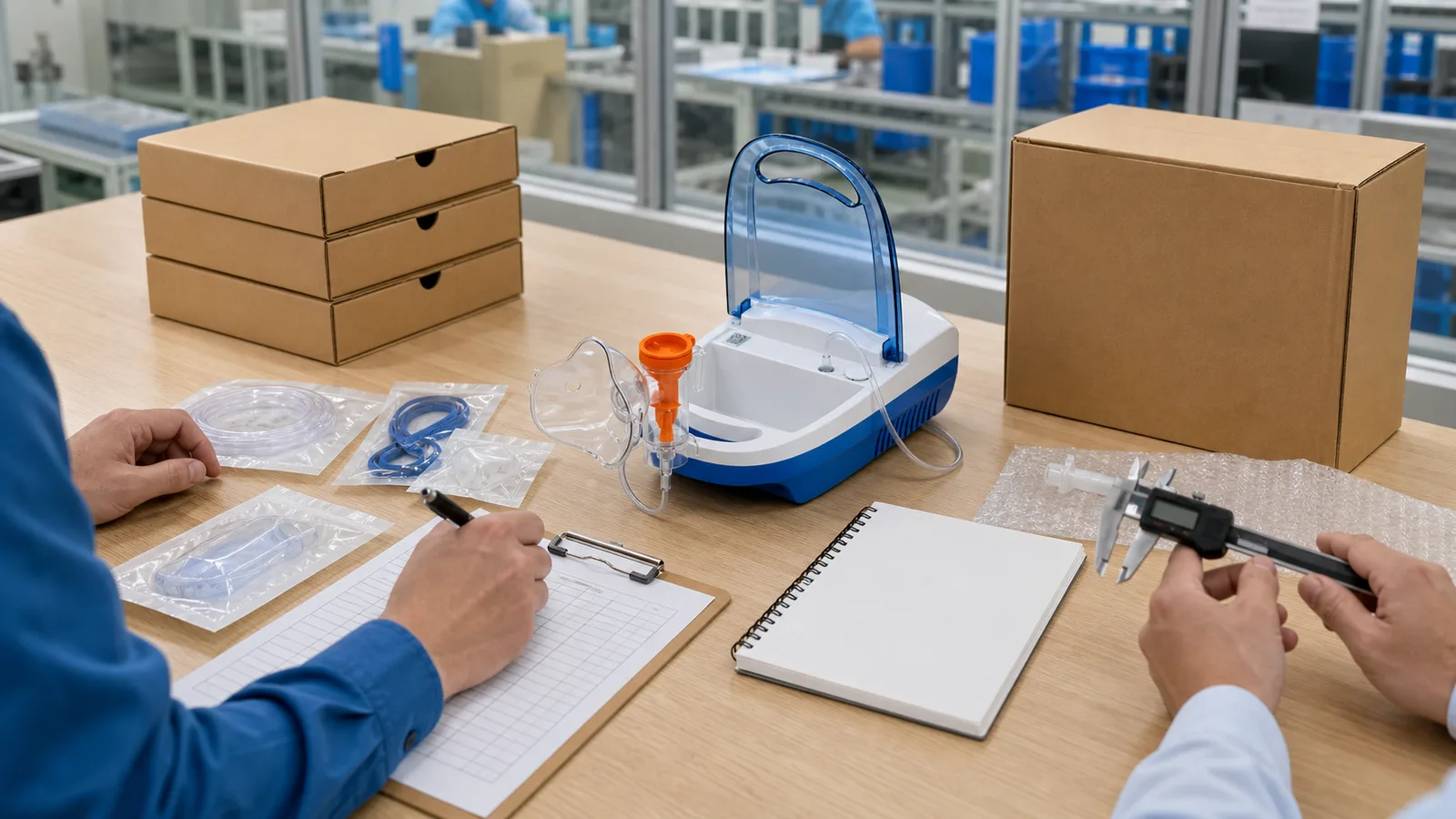
General words such as high quality are not enough for medical device sourcing. Buyers should ask how the supplier checks incoming materials, production process, finished goods, packaging, accessories, and shipment readiness.
Useful questions include what is checked before shipment, how customer-specific packaging and label requirements are verified, whether inspection points can be matched to the selected model, how nonconforming units are handled, and what documents can be provided before final shipment.
The goal is not to collect marketing claims. The goal is to understand whether the supplier can connect quality control to the actual order.
06
Prepare a Better RFQ
A clear RFQ helps the supplier respond accurately. Before asking for a compressor nebulizer quotation, buyers should prepare the target product category, preferred model, destination market, estimated quantity range, required accessories, packaging format, manual language, logo requirements, requested documents, shipment destination, and sample review expectations.
If the buyer does not yet know the right model, the RFQ can ask the supplier to recommend available compressor nebulizer options for a distributor or private-label project. However, the final quotation should still be tied to a specific model and confirmed configuration.
07
How AXDCARE Can Fit the Sourcing Process
AXDCARE's current product structure includes compressor nebulizers for B2B sourcing and OEM/ODM review. Buyers can use the website product category pages to shortlist available models, then contact the AXDCARE team through the existing contact or quotation entry points.
For a reliable discussion, buyers should share their target market, product type, expected configuration, packaging needs, and document checklist. AXDCARE can then review the applicable model information and customization options before quotation.
08
Reference Sources
FDA product classification: Direct Patient Interface Nebulizer, https://www.accessdata.fda.gov/scripts/cdrh/cfdocs/cfpcd/classification.cfm?ID=218
FDA guidance: Reviewer Guidance for Nebulizers, Metered Dose Inhalers, Spacers and Actuators, https://www.fda.gov/regulatory-information/search-fda-guidance-documents/reviewer-guidance-nebulizers-metered-dose-inhalers-spacers-and-actuators
European Commission: Economic operators under medical device rules, https://health.ec.europa.eu/medical-devices-topics-interest/economic-operators_en
Summary
Compressor nebulizer sourcing should be handled as a document-based B2B process, not a simple price comparison. Buyers should connect each quotation to a confirmed model, accessory configuration, packaging requirement, documentation status, and quality review workflow.
For distributor and private-label projects, AXDCARE can review current compressor nebulizer model information and OEM/ODM options through the existing website contact and quotation channels.
Related Links
Product and Sourcing Pages
Frequently Asked Questions
Buyer Questions
What should importers verify before choosing a compressor nebulizer supplier?+
Importers should verify product model availability, accessory configuration, documentation, packaging options, certificate scope if applicable, quality inspection process, and shipment preparation workflow.
Can a supplier's certificate be used for every nebulizer model?+
No. Certificate and test report scope should be reviewed by exact model, legal entity, product category, and destination market. Do not assume one document covers every product.
What information should be included in a compressor nebulizer RFQ?+
A good RFQ should include the target market, product type, preferred model, estimated quantity, accessories, packaging needs, manual language, logo requirements, and requested documents.
Can compressor nebulizers support OEM or private-label projects?+
OEM options may include logo, color, label, manual, accessory, and packaging review depending on the model and project requirements. Exact terms must be confirmed during quotation.
End Article Support
Discuss compressor nebulizer sourcing with AXDCARE
Contact AXDCARE for compressor nebulizer model selection, OEM/ODM review, packaging discussion, and quotation preparation.
Request a QuoteRelated Reading