Industry News · Product Knowledge
Wrist Blood Pressure Monitors: Why Height Still Matters
Why wrist height affects blood pressure readings, what positioning aids can and cannot tell you, and how a supported setup helps with everyday use.
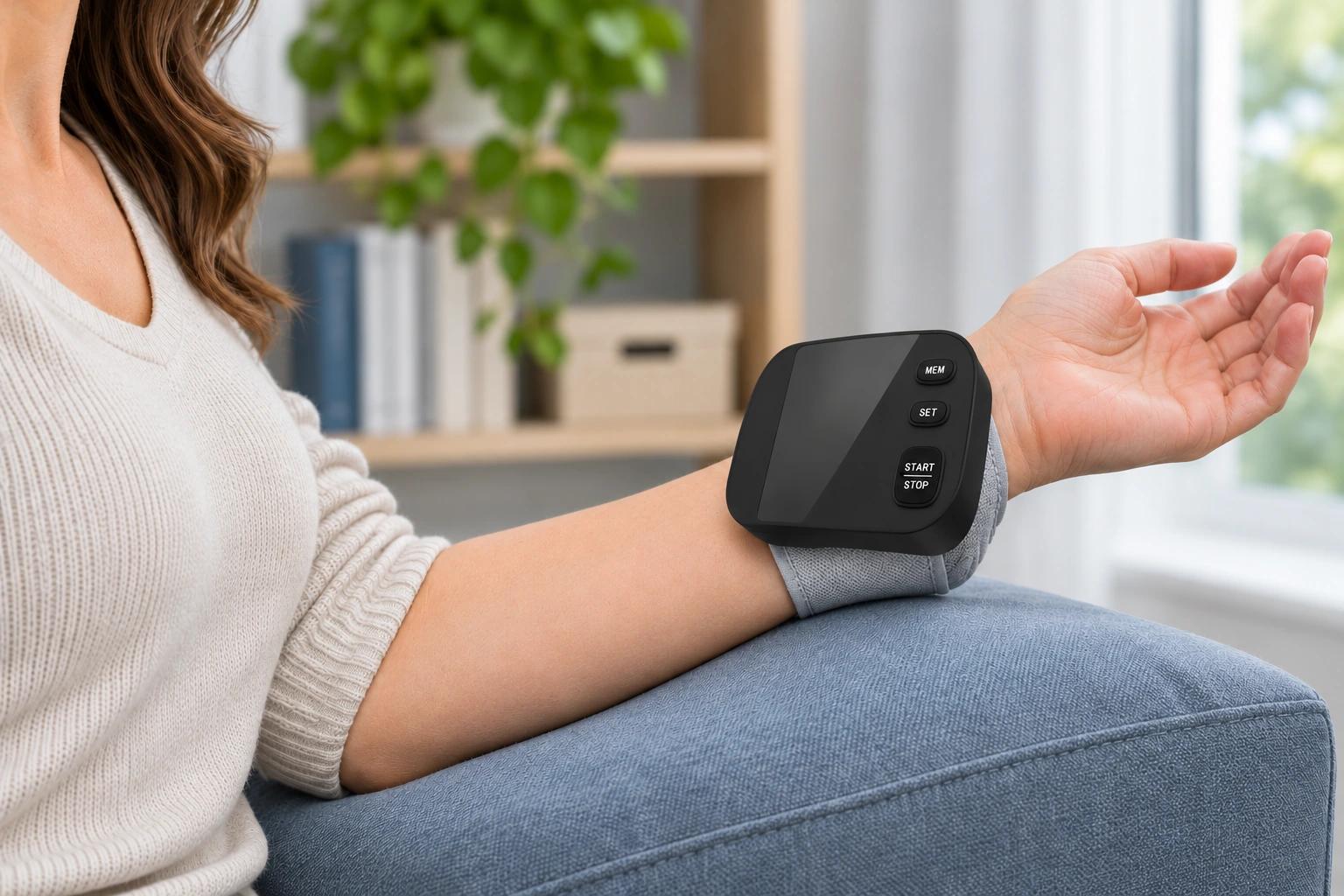
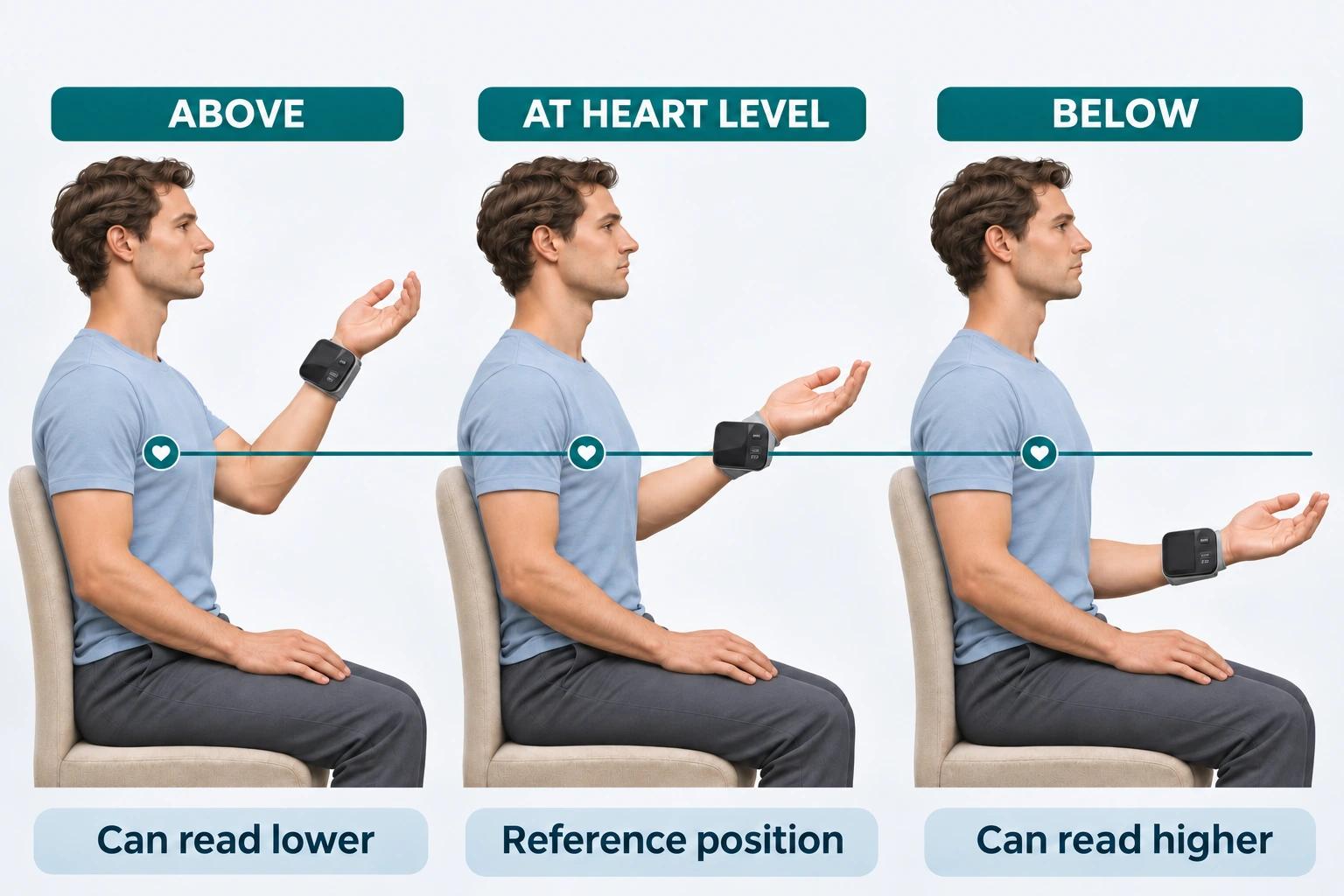
A positioning sensor does not remove the need to keep a wrist blood pressure monitor at heart level. A wrist held too low can produce an artificially high reading; held too high, it can produce an artificially low one. The feature helps guide positioning, but its name alone does not promise automatic correction.
For someone buying a compact monitor, the useful question is therefore practical: can the person comfortably reach and maintain the required position? A reassuring display cue is only one part of that answer.
01
Why height changes the reading
Blood pressure at the wrist depends partly on its vertical position relative to the heart. Lowering the wrist places the measurement site farther below that reference; raising it changes the relationship in the opposite direction. The American Heart Association's measurement statement identifies this directional error specifically for wrist monitors.
Think of heart level as a horizontal reference through the body. Bringing a monitor closer to the chest is not necessarily the same as bringing it to the correct height. Likewise, a hand resting comfortably on a low desk may still leave the wrist below that reference.
This explains why the physical setup deserves attention before judging a number. Changing the wrist's height to obtain a more reassuring result defeats the purpose of a consistent measurement. The goal is to reproduce the correct position, not to search for a preferred reading.
02
A positioning aid is not necessarily a start-up gate
A positioning feature may guide the user without preventing measurement in an unsuitable position. Guidance, permission to start and correction of a result are different functions. Buyers should not treat the presence of one as proof of the other two.
One concrete example appears in the OMRON RS7 Intelli IT instructions. Section 3.1 describes a positioning aid, notes that differences in body size and physique can limit its usefulness, and states that measurement starts five seconds after pressing START/STOP even when the monitor is not positioned properly.
That behavior belongs to this named model. It is not a description of AXDCARE monitors or every wrist device. Its broader lesson is straightforward: a monitor beginning to inflate does not, by itself, prove that the user's height and posture are correct. A feature label cannot tell you which conditions a device checks before starting.
03
Support the arm so the position is sustainable
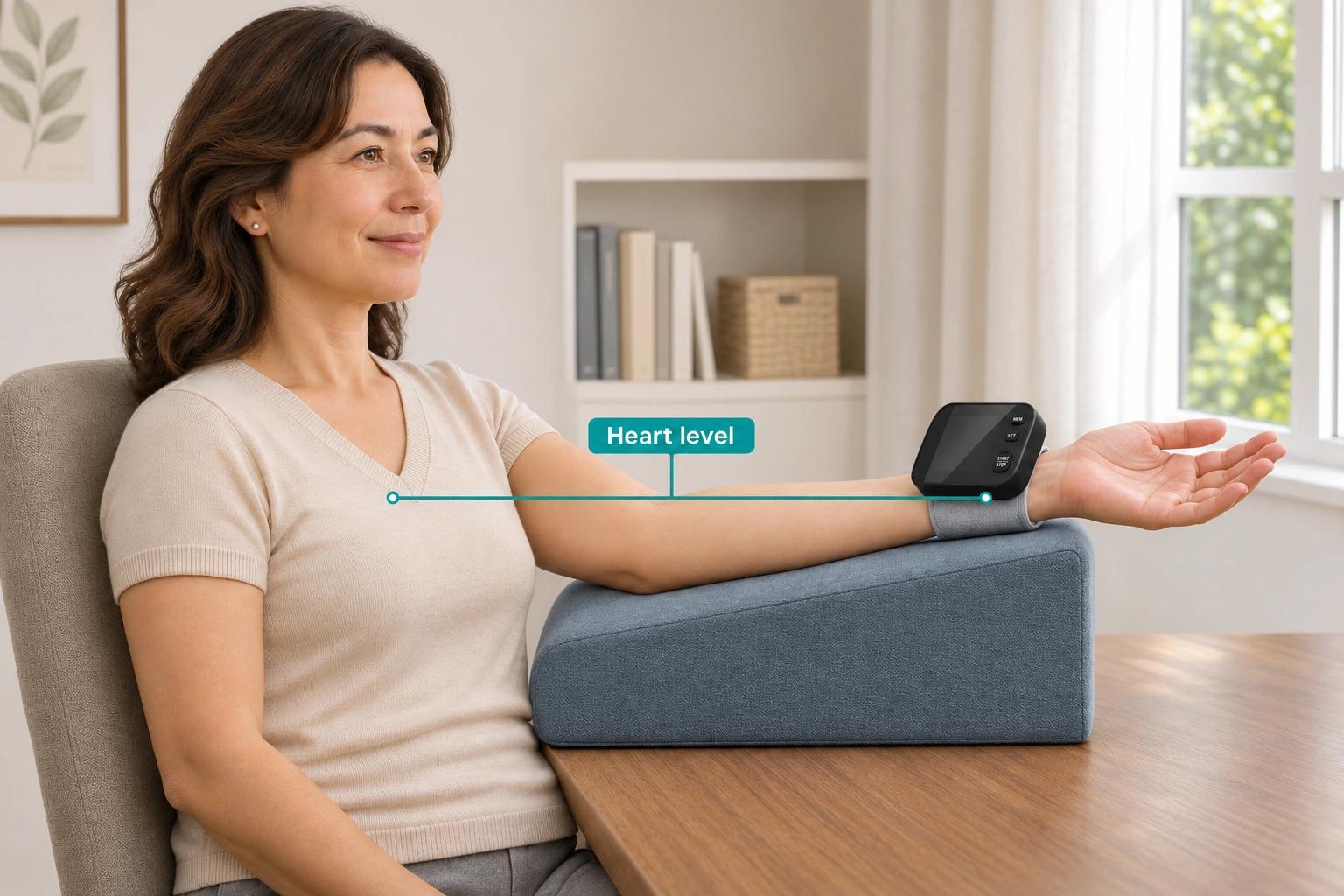
Finding the right height briefly and staying there throughout a measurement are different tasks. A useful setup lets the person remain still without repeatedly lifting, lowering or turning the wrist to see the display. The screen should be readable from the measurement position, rather than requiring a change of pose.
Manufacturer positioning guidance from iHealth emphasizes maintaining heart-level wrist height throughout measurement and supporting the arm. Its particular cuff placement and support arrangement belong to its own device; those details should not be copied as universal instructions.
For a practical demonstration, use the person's normal chair and a suitable support, following the selected monitor's placement instructions. Consider whether the arrangement remains comfortable once measurement begins. If someone can find the position only by hovering an unsupported arm or continually adjusting their seat, a successful momentary cue has not solved the everyday usability problem. Ask a healthcare professional to help establish a workable technique.
04
Choose around the person, not just the positioning feature
The American Heart Association recommends an automatic upper-arm cuff monitor for home use. A wrist positioning feature does not overturn that recommendation. When considering a wrist device, discuss its suitability with a healthcare professional, particularly if using an upper-arm cuff is difficult.
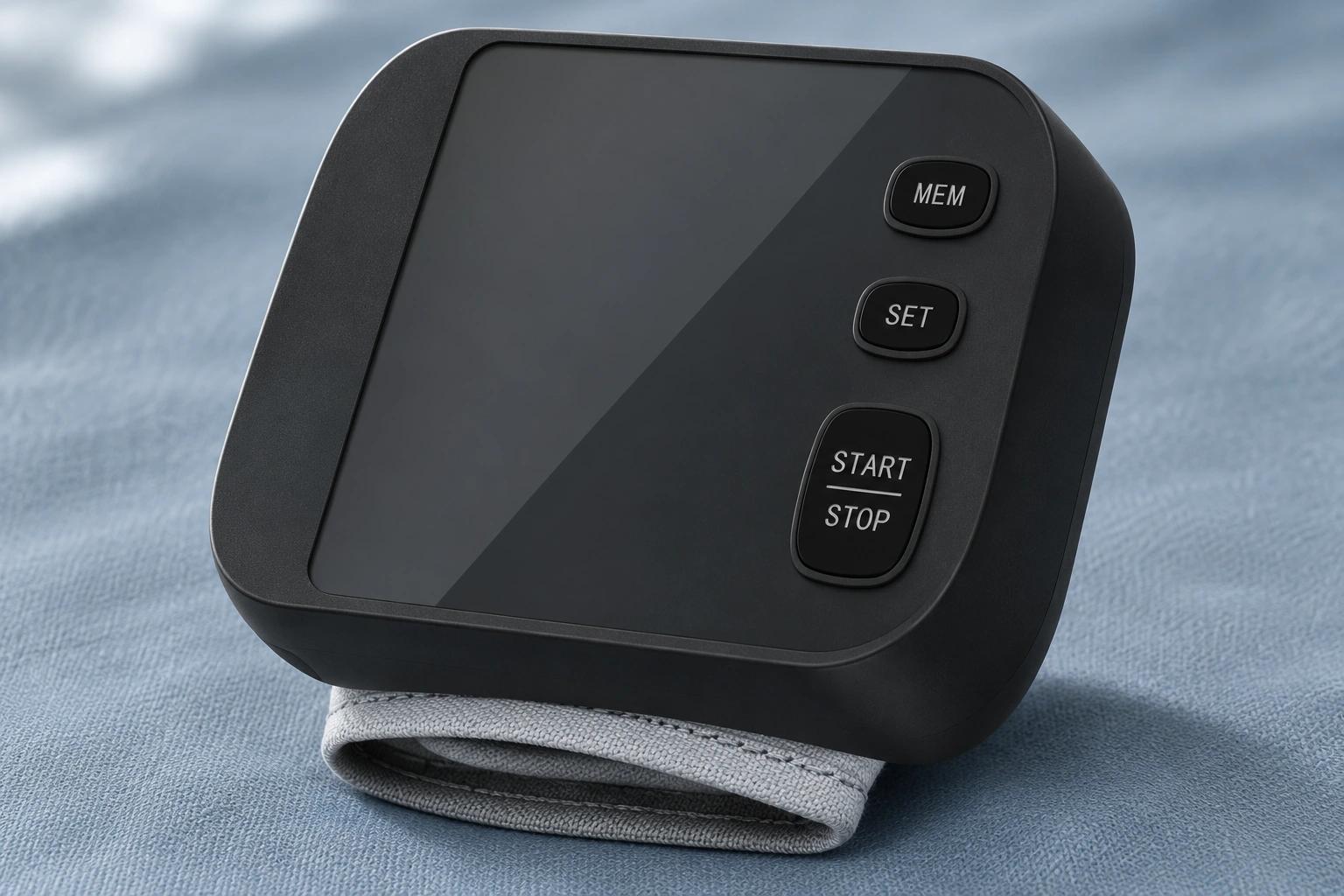
AXDCARE's 2026 catalog lists AXD-BP605 and AXD-BP601 as wrist blood pressure monitors with position sensor detection, connecting this question to the AXDCARE wrist monitor category. The catalog feature does not specify a shared display symbol, positioning threshold or automatic-start behavior, so the OMRON example above should not be read as an operating description for either AXDCARE model.
For pharmacy buyers and household users, the decisive question is whether the complete routine works: applying the cuff, seeing the guidance and maintaining a supported position. A compact shape can be appealing, but comfort during that routine matters more than a feature name on a shelf card. Compare how easily the intended user can repeat the setup, rather than how impressive the feature sounds in isolation.
Related Links
Product and Sourcing Pages
End Article Support
Explore wrist blood pressure monitors
Compare the AXDCARE wrist category around the person and the measurement routine it needs to support.
View wrist monitorsRelated Reading